10 Moving Day Tips for Renting a Storage Unit
Use this size guide to compare bulky furniture, box count, walkway space, climate-control needs, drive-up access, and the questions to ask before reserving a unit.

Size your unit around real furniture, honest box counts, and the walkway you'll actually use
Pick the smallest unit that holds your largest item, all your furniture, and a walkway you can stand in. Count boxes only after the big pieces are placed. In Arkansas, add climate control for anything wood, leather, electronic, or upholstered if it's staying past a hot summer month.
What matters most
Use the article as a decision filter: choose the smallest unit that comfortably fits your load, use climate control for wood, electronics, documents, photos, and fabrics, prioritize access that matches your real schedule, and compare regular rates and fees before trusting the cheapest promotion.
#1Measure your largest item before you look at any unit
Your biggest single piece sets the floor for the whole rental. A queen mattress, a full-size sofa, or a refrigerator decides whether a unit's door and depth even work before boxes enter the conversation. Pull out a measuring tape and write down the length, width, and height of your three largest items. A standard 5×10 gives you 10 feet of depth to lay a mattress flat or stand it against a wall, but a wide sectional or a side-by-side fridge can eat that space fast.
Measure the door opening, not just the unit. A piece that fits the floor plan is useless if it won't clear a 3-foot roll-up door — check the door width and any indoor hallway turns before you sign.
#2Add up boxes only after furniture and appliances are on the list
Box count is the most common way people oversize a unit. Boxes are stackable and flexible; they fill the gaps furniture leaves behind, so counting them first inflates the size you think you need. List every large item first, imagine those placed against the walls, and only then estimate how many boxes ride on top and in between. Twenty to thirty medium boxes usually disappear into the airspace above a dresser and behind a sofa without adding a single square foot.
Use uniform box sizes for the load you'll stack highest. Mismatched boxes create wobble and wasted gaps; a wall of same-size boxes stacks tighter and lets you drop to a smaller unit.
#3Leave a walkway if you'll visit during the rental
A unit packed wall-to-wall is efficient exactly once — the day you load it. If you'll swap seasonal clothes, grab tools, or pull one box a month, plan a center or side aisle wide enough to walk and turn. That aisle costs you real square footage, which often pushes a borderline 5×10 up to a 10×10. Decide up front: is this a seal-it-and-forget-it load, or a unit you'll open regularly? The answer changes the size before you ever compare prices.
Put a strip of tape on the floor at home marking an 18-inch aisle and stage your furniture around it. If everything still fits, you can access the unit without unloading half of it every visit.
#4Choose a 5×10 for tight apartment or dorm overflow
A 5×10 is about the footprint of a large walk-in closet, and it shines for studio and small one-bedroom overflow: a mattress set, a loveseat or small sofa, a dresser, a couple of lamps, and a modest stack of boxes. It's the go-to for a between-leases gap or a college move-out where you're storing a semester's worth of dorm furniture, not a household. If your furniture list is short and you can seal the unit for the summer, this is the size that keeps you from paying for air.
This size works only if you can go vertical — stack boxes above the dresser and sofa arms. If your ceiling height is low or you can't safely stack, treat the 5×10 as full at waist height and step up a size.
#5Step up to a 10×10 when furniture starts to dominate
The moment you're storing a full bedroom plus a living room — a queen or king bed, a full sofa, a dresser, a table, and boxes — the 5×10 stops being realistic and the 10×10 becomes the honest choice. A 10×10 holds roughly one to two rooms of furniture with room to arrange rather than cram. This is the size where the load is defined by couches and case goods, not cartons, and where you can still keep a walkway if you plan the layout.
Disassemble bed frames and table legs to reclaim the 10×10's height. Flat-packed frames slide along a wall and free up the middle of the unit, sometimes buying you enough room to skip the next size up entirely.
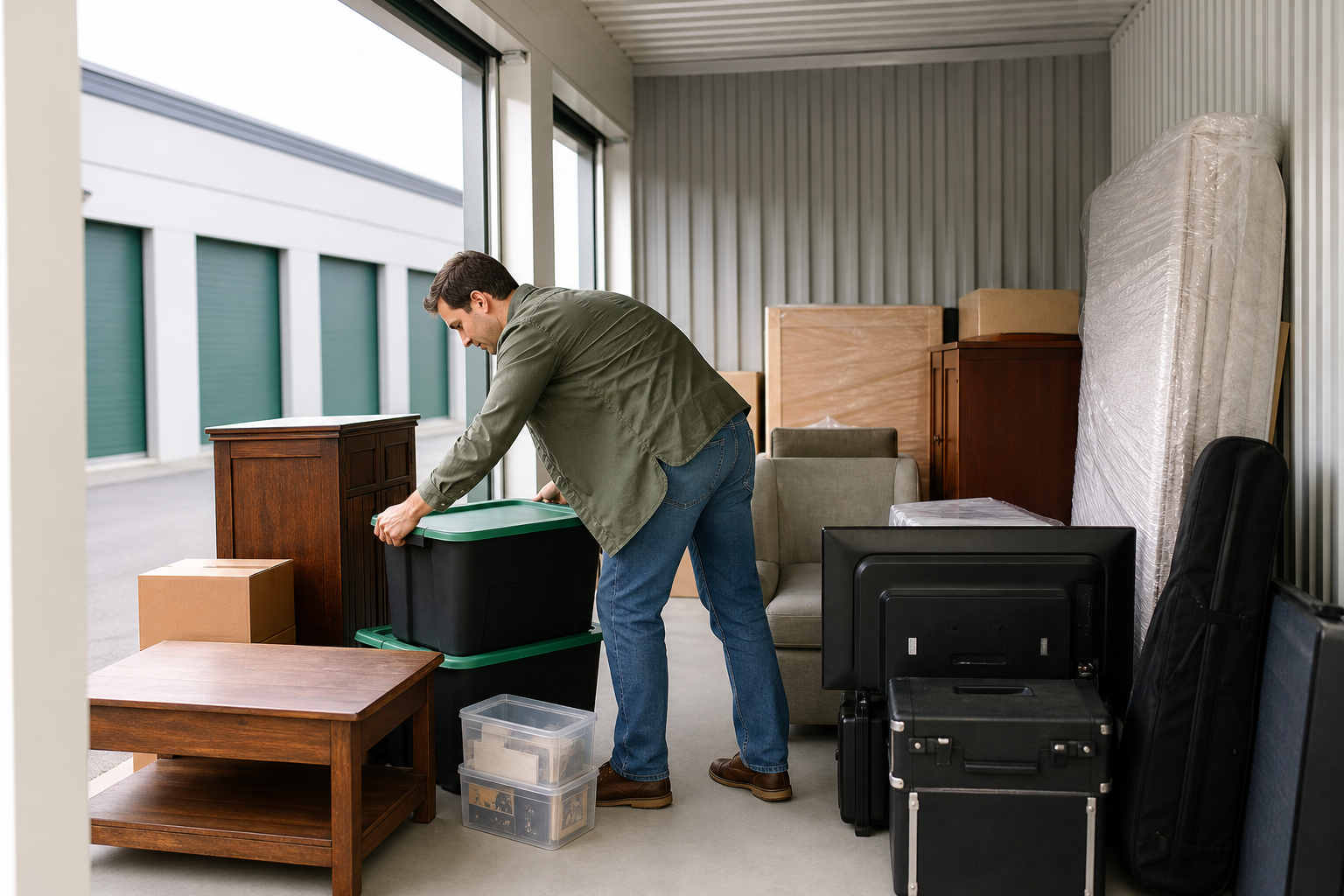
#6Reach for a 10×20 on multi-room and whole-house moves
A 10×20 has a large-garage footprint and is built for the moves a 10×10 can't absorb: multiple bedrooms, a full living room, a dining set, and major appliances like a washer, dryer, and refrigerator. If you're storing an entire house between closings or consolidating two households, this is where large and awkward items get room to breathe. It's also the size that comfortably takes a long sectional, a mattress set, and a wall of boxes without forcing you to play Tetris in August heat.
If you're near the top of a 10×10 and adding a single appliance or a second bedroom, jump to the 10×20 rather than a 10×15. The extra depth pays off when a fridge or long sofa needs a straight, uninterrupted run of wall.
#7Account for shelving, bikes, tools, and awkward items
The items that blow a size estimate are rarely the sofa — they're the freestanding shelving unit, the two bikes, the toolbox, the ladder, and the patio set that don't stack and won't nest. Odd shapes waste more space than their volume suggests because you can't build a clean wall around them. Inventory these separately and give them a dedicated corner in your mental layout. A single upright bookshelf or a bike leaned against a wall can quietly claim two feet of floor you were counting on.
Store your own shelving inside the unit and load boxes onto it. It turns dead vertical space into organized storage and can keep an awkward-item-heavy load from forcing you up a size.
#8Stack for stability instead of chasing a perfect floor plan
A tidy diagram falls apart the second a box tower leans. Space efficiency comes from safe stacking, not from squeezing every gap: heaviest boxes on the bottom, lightest on top, flat surfaces stacked on flat surfaces. Put appliances and dressers against the walls as your vertical anchors, then build boxes up in front of them. A stable stack lets you use the full height of a 10×10 or 10×20 — which is often what saves you from renting the larger unit in the first place.
Leave drawers full of soft, light items and slide them back in — clothing and linens inside a dresser store for free and add no height. Just don't fill drawers with anything heavy enough to make the piece tip when you move it.
#9Price the next size up before you force a tight fit
The jump from a 5×10 to a 10×10, or a 10×10 to a 10×20, is often smaller than movers expect — and far cheaper than a damaged sofa or a second trip because everything didn't fit. Before you lock in the tight unit, get the monthly difference for the next size and weigh it against the risk of arriving on moving day to find your load won't close the door. Watch for administrative fees, required insurance, and whether a promo rate jumps after the first month, so you're comparing real costs, not headline numbers.
Ask what the standard rate is after any introductory promo ends. A cheap first month on a too-small unit is a bad deal if you have to move everything to a larger one in 60 days and pay a second set of move-in fees.
#10Size the unit around move-out, not just move-in day
The way you pack on day one isn't the way the unit will live. If you'll add boxes over the summer, retrieve winter gear, or pull furniture out one piece at a time, the load needs to flex without a full unpack. Think about how and when you'll empty it: a campus move-out in August means you'll want drive-up access and a straight path for a fast, hot-day load-out, while a long between-homes stay favors an indoor climate-controlled unit that protects wood and upholstery through Arkansas humidity. Pick the size and access that fit the exit, not only the entrance.
Load the items you'll need first — seasonal clothes, tools, one specific box — nearest the door, and note where they are. It turns move-out and mid-stay visits into a two-minute grab instead of an unload-and-reload.
Quick summary
| Decision | What to check | Why it matters |
|---|---|---|
| Largest item first | Length, width, height of your three biggest pieces and the door opening | Your biggest item sets the minimum unit and can rule out a size before boxes count |
| Box count | Number of boxes after furniture is placed against walls | Counting boxes first oversizes the unit; they fill gaps furniture leaves |
| Walkway | Whether you'll visit and need an 18-24 inch aisle | An aisle costs square footage and can push a 5×10 to a 10×10 |
| Size tier | 5×10 for overflow, 10×10 when furniture dominates, 10×20 for whole-house | Matching the tier to the load keeps you from paying for empty space |
| Climate control | Whether items are wood, leather, electronic, or staying past a summer month | Arkansas humidity above 70% warps, mildews, and corrodes sensitive belongings |
| Access and terms | Drive-up vs indoor, access hours, fees, and post-promo rate | The right access and clear pricing matter more than the cheapest teaser rate |

Storage numbers worth checking
Use these numbers as decision anchors before comparing facilities. The goal is not to guess a perfect unit — it is to compare the same details across options.
List largest items, box count, and aisle needs.
Use these as comparison anchors.
Monthly rate, promo length, required fees.
Drive-up convenience vs. indoor protection.
| Check | What to compare | Why it matters |
|---|---|---|
| 5×10 | Boxes, small bedroom, seasonal items | A small unit can save money if it truly fits |
| 10×10 | Apartment contents or household overflow | Often a safer middle option for mixed items |
| 10×20 | Multi-room moves or large equipment | More room can reduce loading frustration |
| Climate control | Sensitive vs. durable belongings | Arkansas heat and humidity change the risk |
StorageGuide verdict
Use the article as a decision filter: choose the smallest unit that comfortably fits your load, use climate control for wood, electronics, documents, photos, and fabrics, prioritize access that matches your real schedule, and compare regular rates and fees before trusting the cheapest promotion.
Storage FAQs
How do I know if I need a 5×10 or a 10×10?
Start with your furniture, not your boxes. If your load is a mattress, a small sofa, a dresser, and boxes you can stack vertically, a 5×10 usually works. Once you add a full-size sofa plus a second room of furniture, or you want a walkway, step up to a 10×10 — which holds roughly one to two rooms of furnishings with space to arrange.
When is a 10×20 actually worth it?
A 10×20 has a large-garage footprint and fits a two- to three-bedroom home, including major appliances. Reach for it on multi-room or whole-house moves, or when you're at the top of a 10×10 and adding an appliance or another bedroom. Its extra depth is what lets a refrigerator or long sectional sit against a straight, uninterrupted wall.
Do I need climate control for a moving-day storage unit in Arkansas?
For anything wood, leather, upholstered, electronic, or sentimental staying past about a month, yes. Arkansas summer humidity routinely runs above 70%, and unconditioned units swing between heat and moisture that warps wood, mildews fabric, and corrodes electronics. Durable items like tools, plastic bins, and metal furniture stored short-term are usually fine in a standard drive-up unit.
How much walkway space should I leave?
If you'll visit the unit, leave an 18-to-24-inch aisle so you can walk in and turn without moving stacks. If it's a seal-it-and-forget-it load you won't touch until move-out, you can pack wall-to-wall and choose a smaller unit. Decide which kind of stay it is before you pick the size.
Should I just pick the cheapest unit I can find?
No. Compare the true monthly cost — including any administrative fees, required insurance, and the rate after an introductory promo ends — and weigh a slightly larger unit against the cost of a damaged item or a second move. The right access, access hours, and clear terms matter more than a headline teaser price.
Find the right-sized unit before moving day
Compare unit sizes, climate control, and access across Arkansas facilities so you rent exactly what your furniture and boxes need — no paying for empty space.