9 Ways to Save Space in a Storage Unit
Use this size guide to compare bulky furniture, box count, walkway space, climate-control needs, drive-up access, and the questions to ask before reserving a unit.

Size a storage unit around your biggest items and real box count — not guesswork — so you stop paying for empty air.
The fastest way to right-size a storage unit is to start with the largest thing you're storing, add furniture and appliances, then count boxes last. Once you have that list, you can compare a 5×10 for apartment overflow, a 10×10 when furniture takes over, and a 10×20 for multi-room moves. Beyond size, decide whether you need climate control for wood, electronics, and upholstery in Arkansas heat and humidity, whether you want drive-up or indoor access, and check price, fees, and access hours before renting.
What matters most
Use the article as a decision filter: choose the smallest unit that comfortably fits your load, use climate control for wood, electronics, documents, photos, and fabrics, prioritize access that matches your real schedule, and compare regular rates and fees before trusting the cheapest promotion.
#1Measure your largest item before anything else
Your biggest single item sets the floor for unit size, so measure it before you think about boxes. A queen mattress runs about 60 by 80 inches, a standard sofa is roughly 84 inches long, and a full-size refrigerator can be 36 inches wide and over 6 feet tall. Whatever won't bend, fold, or disassemble is the item you have to design the unit around. If your longest piece can't lie flat or stand upright in a 5×10, you already know that size is out.
- Measure length, width, and height of your longest item
- Note anything that can't be disassembled
- Confirm it clears the unit's door opening
Pull out a tape measure and check the unit door width too, not just the interior — a 30-inch doorway can stop a sofa or fridge that would otherwise fit inside.
#2Count boxes only after furniture and appliances are listed
Boxes are flexible; furniture isn't. If you size a unit by box count first, you'll almost always guess wrong because boxes stack into the gaps furniture leaves behind. List every large item, place them mentally against the walls, and only then figure out how many boxes fit on top and in between. This ordering keeps you from renting extra square footage just to hold a few cartons that could have ridden on a dresser or under a table.
- Furniture and appliances first
- Boxes fill the leftover volume
- Heavy boxes on the bottom, light on top
Standardize on one or two box sizes. Uniform boxes stack square and tight, while mismatched cartons leave dead space that fools you into thinking you need a bigger unit.
#3Leave a walkway if you'll visit during storage
A unit packed wall to wall looks efficient until you need the one box at the back. If you plan to rotate seasonal gear, pull out holiday decorations, or grab a tool now and then, reserve a narrow center aisle so you can reach the rear without unloading everything. That aisle costs you some capacity, which is exactly why it belongs in your sizing math — a unit you can't walk into is functionally smaller than its label.
- Store frequently-needed items near the front
- Face labels toward the walkway
- Skip the aisle only for true set-and-forget storage
Put items you'll need soonest nearest the door and label boxes on the side facing the aisle, so a quick visit doesn't turn into a full excavation.
#4Choose a 5×10 for compact apartment overflow
A 5×10 is about 50 square feet — roughly the footprint of a walk-in closet — and it handles a studio or one-bedroom's overflow well. Think a mattress set on edge, a small sofa or loveseat, a dresser, a few chairs, and a stack of boxes along one wall. It's the right call for a lease gap, a roommate change, or clearing a spare room. It gets tight fast once you add a full dining set or major appliances, so be honest about how much furniture is really going in.
- Mattress set, small sofa, dresser, boxes
- Great for lease gaps and spare-room clearing
- Tight once appliances or a dining set arrive
Stand the mattress and sofa on their long edges against the wall. That single move often frees up enough floor for the boxes and keeps you in a 5×10 instead of jumping a size.
#5Step up to a 10×10 when furniture dominates the load
At about 100 square feet, a 10×10 is the tipping point where furniture, not boxes, is driving your decision. It comfortably takes the contents of one or two furnished rooms: a full sofa, a bed set, a dresser, a dining table with chairs, and a washer or dryer, plus boxes stacked on top. If your inventory list has more large pieces than you can line against two 5×10 walls, this is usually the honest fit rather than cramming into the smaller unit.
- Sofa, bed set, dresser, dining set, one appliance
- Disassemble frames to reclaim floor space
- The right size when big items outnumber boxes
Break down bed frames and table legs before you load. Flat-packed frames slide vertically against a wall and can be the difference between a relaxed 10×10 and a jammed one.
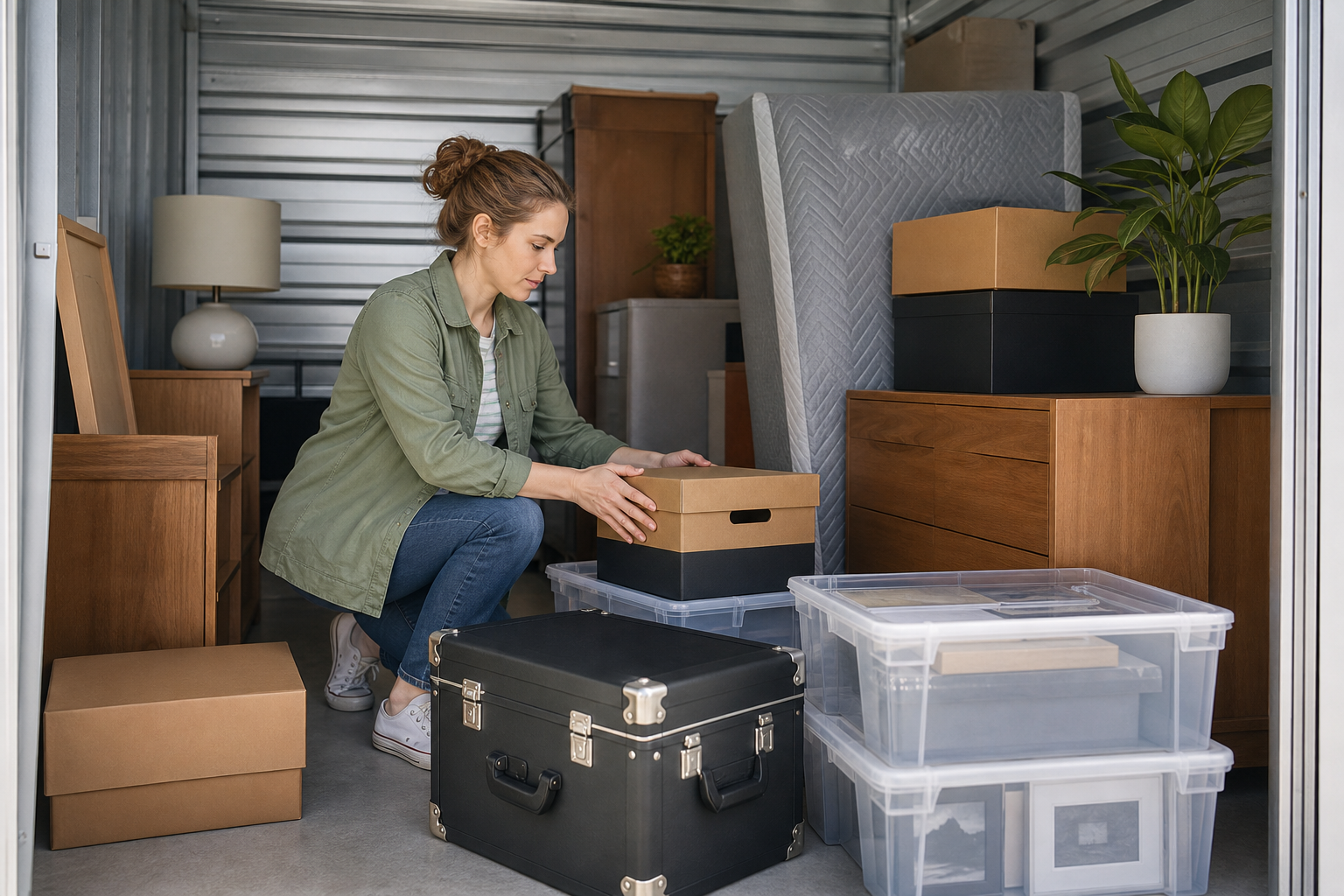
#6Consider a 10×20 for multi-room moves and oversized items
A 10×20 is roughly 200 square feet — about a one-car garage — and it's built for whole-home moves or storing several rooms at once. It swallows major appliances, multiple mattress sets, a full living and dining room, and the long, awkward pieces that never fit elsewhere: an armoire, a sectional, a mattress plus box spring plus headboard. For an in-between-homes stretch or a summer campus-to-summer-job gap where an entire apartment goes into storage, this is the size that keeps you from renting two smaller units.
- Multiple rooms plus large appliances
- Room for long, awkward items
- Compare against two mid-size units on price
If you're deciding between two 10x10s and one 10×20, price both. One larger unit is often easier to load and cheaper to access than paying two door fees and splitting your inventory across separate spaces.
#7Account for shelving, bikes, tools, and awkward items
The items that blow up a sizing estimate are rarely the sofa — they're the odd shapes nobody counts. Freestanding shelving, bikes, ladders, golf clubs, a grill, a lawn mower, and loose tools all claim floor space that furniture can't absorb. Walk through the garage, closet, and shed and add these to your list before you commit, because five or six awkward pieces can quietly consume the walkway you were counting on.
- Inventory the garage and shed, not just rooms
- Use vertical space for bikes and ladders
- Nest small tools inside larger hollow items
Hang bikes and ladders on the wall or lean them in a corner behind furniture, and nest smaller tools inside empty appliance drums or drawers to recover the floor.
#8Stack safely instead of relying on a perfect floor plan
Storage units are taller than most people use — often 8 feet or more — and that vertical space is free capacity you already paid for. Stacking correctly lets a smaller unit do a bigger unit's job: heavy, sturdy boxes on the bottom, lighter and more fragile ones on top, with flat furniture surfaces like dressers and tables used as stable bases. The goal isn't a flawless Tetris layout on the floor; it's building stable towers that stay put.
- Heavy on the bottom, fragile on top
- Use furniture tops as stacking bases
- Keep hand-moved stacks below eye level
Cap each stack below eye level for anything you'll move by hand. Towers that need a ladder tempt you to yank the bottom box out, and that's how a whole stack comes down.
#9Compare the next size up before forcing a tight fit
When your inventory lands right at the edge of a size, price the next unit up before you commit to squeezing. A too-small unit costs you in ways the sticker doesn't show: no walkway, stacks you can't stabilize, and belongings you have to unload every time you visit. If the step up is a modest monthly difference, the added room and easier access often justify it. Weigh that gap against how long you'll rent and how often you'll be in and out.
- Price both sizes over your full rental period
- Factor in walkway and stacking room
- Don't let month-one pricing decide the size
Do the math per month over your expected rental length, not just month one. A promotion can hide the real difference between sizes; compare the ongoing rate and any fees on both before deciding.
Quick summary
| Decision | What to check | Why it matters |
|---|---|---|
| Largest item | Length, height, and door clearance | Your biggest piece sets the minimum unit size |
| Box count | Boxes counted after furniture is placed | Boxes fill gaps, so sizing by them first overshoots |
| Walkway | Room to reach the back if you'll visit | A packed unit is functionally smaller than its label |
| 5×10 vs 10×10 | How many large items you're storing | Furniture-heavy loads outgrow a 5×10 quickly |
| 10×20 | Multi-room load and oversized pieces | One large unit can beat two smaller ones on cost and access |
| Climate control | Wood, electronics, upholstery in the load | Arkansas heat and humidity warp and mildew sensitive items |
| Size up | Monthly cost gap over full rental | A tight fit costs in access and stacking, not just space |
Storage numbers worth checking
Use these numbers as decision anchors before comparing facilities. The goal is not to guess a perfect unit — it is to compare the same details across options.
List largest items, box count, and aisle needs.
Use these as comparison anchors.
Monthly rate, promo length, required fees.
Drive-up convenience vs. indoor protection.
| Check | What to compare | Why it matters |
|---|---|---|
| 5×10 | Boxes, small bedroom, seasonal items | A small unit can save money if it truly fits |
| 10×10 | Apartment contents or household overflow | Often a safer middle option for mixed items |
| 10×20 | Multi-room moves or large equipment | More room can reduce loading frustration |
| Climate control | Sensitive vs. durable belongings | Arkansas heat and humidity change the risk |
StorageGuide verdict
Use the article as a decision filter: choose the smallest unit that comfortably fits your load, use climate control for wood, electronics, documents, photos, and fabrics, prioritize access that matches your real schedule, and compare regular rates and fees before trusting the cheapest promotion.
Storage FAQs
How do I know if I need a 5×10 or a 10×10?
List your furniture and appliances first. If they'd line up along the walls of a 5×10 with room for a mattress on edge and a wall of boxes, the 5×10 works. Once you have a full sofa, a bed set, a dining set, and an appliance, the large items usually outnumber what fits in a 5×10, and a 10×10 becomes the honest fit.
Is climate control worth it for a short storage stint?
It depends on what you're storing more than how long. Even a few summer weeks of Arkansas heat and humidity can warp wood, cloud electronics, and encourage mildew in upholstery. If your load is mostly plastic bins, metal, and sealed goods, standard storage is usually fine; if it includes furniture, instruments, or electronics, climate control is the safer choice.
Should I leave empty space in the unit?
Only a walkway, and only if you'll visit. If the unit is set-and-forget, you can pack it fuller. If you'll pull items in and out, reserve a narrow center aisle and keep frequently-needed boxes near the door so you don't have to unload the whole unit for one item.
Drive-up or indoor access — which should I pick?
Drive-up units make loading heavy furniture and appliances faster because you back right up to the door. Indoor units are typically more protected from temperature swings and weather. If you're moving big items yourself, weigh the loading convenience of drive-up against the added protection of an indoor or climate-controlled space.
What should I ask before renting?
Confirm the ongoing monthly rate beyond any promotion, any administrative or insurance fees, the access hours, whether the unit is drive-up or indoor, and whether climate control is available in the size you need. Then measure your largest item against the unit door before you sign.
Find a unit that fits — without the empty space
Compare unit sizes, climate control, and access side by side, then pick the smallest space that comfortably holds your biggest item and your boxes.