5×10 vs 10×10 Storage Units
Use this size guide to compare bulky furniture, box count, walkway space, climate-control needs, drive-up access, and the questions to ask before reserving a unit.

How to pick between a closet-sized unit and a small-bedroom-sized one without renting air you'll never fill.
A 5×10 gives you about 50 square feet (a walk-in closet); a 10×10 gives you about 100 square feet (a small bedroom). Choose based on your largest items and whether you'll need a walkway. This guide compares the two on fit, cost, access, and climate control, plus what to ask before you rent in the Arkansas heat.
What matters most
Use the article as a decision filter: choose the smallest unit that comfortably fits your load, use climate control for wood, electronics, documents, photos, and fabrics, prioritize access that matches your real schedule, and compare regular rates and fees before trusting the cheapest promotion.
Size by your bulky items, not your box count
Boxes are flexible; a sofa is not. That's why sizing should start with your largest, least-stackable pieces. A 5×10 is essentially a single deep lane, so it works when your big items are a mattress set and one couch that can line the walls, with boxes filling the gaps above and beside them. Once you have two large soft items (say a mattress plus a sectional) or a rigid piece like a dresser or a washer that can't nest against anything, that single lane runs out fast and a 10×10 gives you a second row to work with.
Lay out your three biggest items on the floor at home with a tape measure and mark a 5-foot by 10-foot rectangle in painter's tape. If those items alone eat more than two-thirds of the box, you're a 10×10 renter.
Use the common sizes as ranges, not exact promises
A 5×10 is widely quoted as holding a studio or small one-bedroom; a 10×10 is quoted as holding multiple rooms of furniture. Treat those as ceilings, not guarantees. Real fit depends on how much stacks and how tall the unit is. Most units run about 8 feet high, so a 5×10 that looks full at eye level often has usable air above the furniture. If your list is a queen mattress, a small couch, a bookshelf, and 15 to 20 boxes, you're squarely in 5×10 territory. Add a second bed frame, a table, or 30-plus boxes and you've crossed into 10×10 range.
- 5×10 range: studio to tight one-bedroom, mattress + couch + moderate boxes
- 10×10 range: one-to-two bedrooms, added dresser/table/appliance
- On the line? Count cubic feet and measure ceiling height
Convert everything to cubic feet, not floor feet, when you're on the line. A 10×10 at 8 feet tall is roughly 800 cubic feet versus 400 for a 5×10 — the difference is whether you can safely stack four feet high without a wall of falling boxes.
Leave a walkway if you'll actually visit
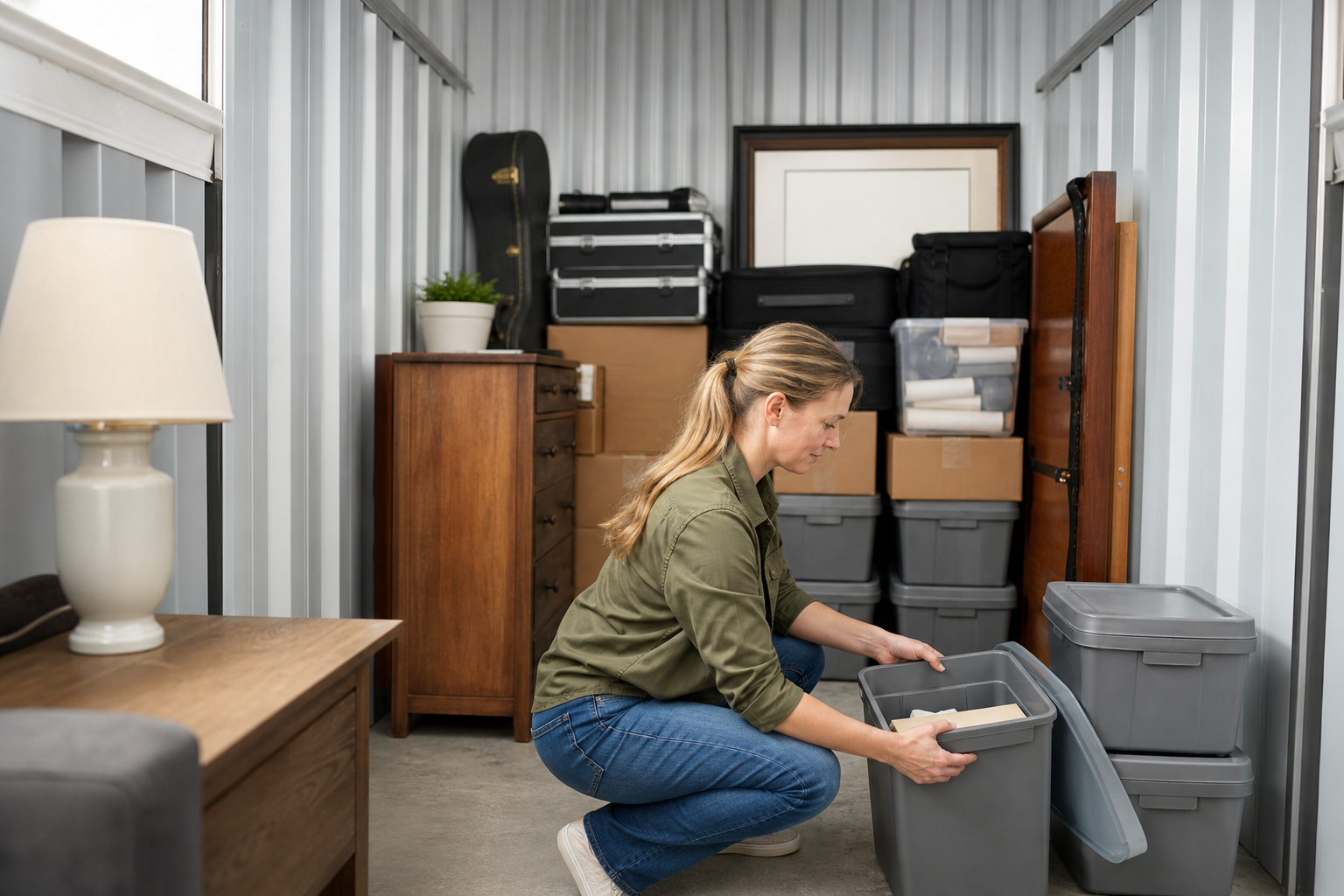
The size that fits everything and the size you can move around in are two different units. If you'll drop things in once and not return for months, you can pack a 5×10 wall-to-wall. But if you'll swap seasonal gear, pull a specific box, or rotate business inventory, you need a center aisle — and a wall-to-wall 5×10 has no room for one. A 10×10 lets you keep a walking lane down the middle and still shelve both sides. Drive-up units make short visits easier; indoor units usually mean a hallway and a cart, which is fine for planned trips but slower for grab-and-go.
If you expect to visit more than once a month, buy your walkway on purpose: pack the 10×10 as two 3-foot-deep shelving walls with a 3-foot aisle, and put anything you'll reach for near the door.
Climate control matters more than one size step
In Arkansas, summer heat and humidity do real damage to the exact items people store: wood furniture can warp, upholstery and mattresses can grow mildew, and electronics, photos, and paper degrade in swings of temperature. That risk doesn't change between a 5×10 and a 10×10 — but the decision often gets tangled together because climate-controlled units cost more. Don't downsize sensitive belongings into a smaller standard unit just to offset the climate-control premium. It's better to store a mattress and a wood dresser in a climate-controlled 5×10 than to cram them into a cheaper, non-climate 10×10 and pull out warped furniture in September.
Split the decision in two: first decide standard vs. climate-controlled based on your items, then pick 5×10 vs. 10×10 based on volume. Bundling the two questions is how people end up overpaying for space or under-protecting their stuff.
Compare the next size up before you force a tight fit
The price gap between a 5×10 and a 10×10 is often smaller than people assume, and a too-tight 5×10 has hidden costs: a second trip when it won't all fit, damage from over-stacking, or renting a second small unit later. Before you lock in the smaller size, price the 10×10 at the same facility and weigh the monthly difference against the risk of a repack. Also read the whole price, not the headline: intro rates can step up after a few months, and admin fees or required insurance change the real number. The cheapest promotion on a unit that doesn't fit isn't the cheapest option.
- Price both sizes at the same facility, not across two facilities
- Ask about admin fees, required insurance, and rate increases
- Factor the cost of a second trip or a repack into the 5×10
Ask what the rate becomes after any promo period and whether the price is locked or can increase — then compare the 10×10's steady-state cost to the 5×10's. If the gap is only a few dollars, size up and skip the tight pack.
Quick summary
| Decision | What to check | Why it matters |
|---|---|---|
| 5×10 (~50 sq ft) | Mattress + couch + ~15–20 boxes, single deep lane | Cheapest fit for studio/1-bedroom overflow if you won't need a walkway |
| 10×10 (~100 sq ft) | Second bed, dresser, appliance, 30+ boxes, or center aisle | Holds multiple rooms and leaves room to reach the back |
| Ceiling height | Usable vertical space (~8 ft typical) | Stacking safely can keep you in the smaller size |
| Access style | Drive-up vs. indoor; how often you'll visit | Frequent visits need a walkway; grab-and-go favors drive-up |
| Climate control | Wood, upholstery, electronics, photos, paper | Arkansas heat and humidity damage these regardless of unit size |
| Total price | Post-promo rate, fees, required insurance | The cheapest intro rate on a too-small unit isn't the cheapest overall |

Storage numbers worth checking
Use these numbers as decision anchors before comparing facilities. The goal is not to guess a perfect unit — it is to compare the same details across options.
List largest items, box count, and aisle needs.
Use these as comparison anchors.
Monthly rate, promo length, required fees.
Drive-up convenience vs. indoor protection.
| Check | What to compare | Why it matters |
|---|---|---|
| 5×10 | Boxes, small bedroom, seasonal items | A small unit can save money if it truly fits |
| 10×10 | Apartment contents or household overflow | Often a safer middle option for mixed items |
| 10×20 | Multi-room moves or large equipment | More room can reduce loading frustration |
| Climate control | Sensitive vs. durable belongings | Arkansas heat and humidity change the risk |
StorageGuide verdict
Use the article as a decision filter: choose the smallest unit that comfortably fits your load, use climate control for wood, electronics, documents, photos, and fabrics, prioritize access that matches your real schedule, and compare regular rates and fees before trusting the cheapest promotion.
Storage FAQs
Will a queen mattress and a sofa fit in a 5×10?
Yes. A queen mattress with box spring plus a standard sofa lines the walls of a 5×10 comfortably, with room above and beside them for boxes. The 5×10 gets tight once you add a second large soft item, a dresser, or an appliance — that's the point to look at a 10×10.
How many boxes does each size hold?
It depends on box size and how high you stack, but as a planning range a 5×10 handles roughly the boxes from a studio or small one-bedroom alongside a couple of furniture pieces, while a 10×10 handles multiple rooms' worth. Count cubic feet rather than box quantity when you're on the border between the two.
Do I need climate control in Arkansas for either size?
If you're storing wood furniture, upholstery, mattresses, electronics, photos, or paper through the summer, climate control is worth it regardless of unit size, because heat and humidity — not square footage — are what cause warping and mildew. Decide climate control based on your items first, then pick the size.
Is a 10×10 worth the extra cost over a 5×10?
If the monthly difference is small and you're at all on the fence, yes — the 10×10 gives you a walkway, room to stack safely, and slack for items you forgot. If your list is genuinely short and stable, the 5×10 saves money. Price both at the same facility, including the post-promo rate, before deciding.
How do I measure before renting?
Use a tape measure to mark a 5×10 and a 10×10 footprint on the floor at home, then arrange your largest items inside it. Note the unit's ceiling height too, since usable vertical space can keep you in the smaller unit. If your big items alone fill most of the smaller box, size up.
Match your list to the right size
Line up your biggest items, count your boxes, and decide whether you'll need a walkway — then compare 5×10 and 10×10 options, including climate control and access hours, in one place.