Moving and Packing Guide for Storage Units
Use this size guide to compare bulky furniture, box count, walkway space, climate-control needs, drive-up access, and the questions to ask before reserving a unit.

Size your unit around the big stuff and a walkway, not a rough box count
Most people overpay by renting the size that 'sounds safe' or underpay and end up wrestling a sofa through a too-small door. The fix is to size the unit around your bulky items first, add box volume second, and leave a walkway if you plan to visit. This guide walks through common Arkansas unit sizes as planning ranges, when to jump to the next size up, and where climate control, drive-up vs indoor access, access hours, and fees change your pick before you sign.
What matters most
Use the article as a decision filter: choose the smallest unit that comfortably fits your load, use climate control for wood, electronics, documents, photos, and fabrics, prioritize access that matches your real schedule, and compare regular rates and fees before trusting the cheapest promotion.
Size around your bulky items first, not your box count
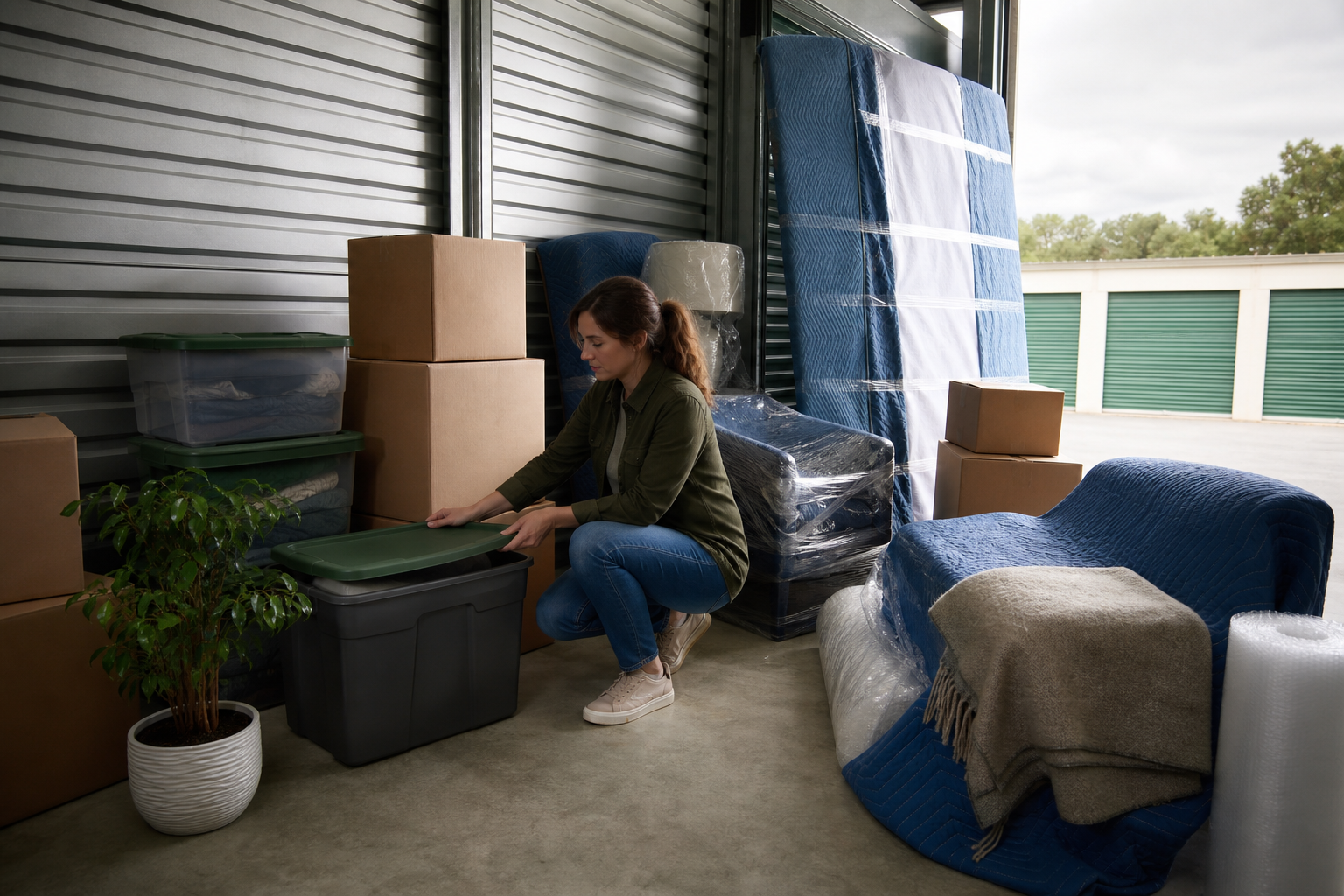
Boxes are flexible — they stack, shift, and fill gaps. Furniture and appliances don't. So the item that actually decides your unit size is usually your largest one: a queen mattress, a three-seat sofa, a refrigerator, or a dresser. List those big pieces first and note which ones can't be disassembled or laid flat. A sofa that only fits upright, or a mattress you'd rather not fold, eats floor space that no amount of clever box stacking gets back. Once the bulky items have a home, boxes fill the vertical space above and around them.
- Measure your longest item (often a sofa or mattress) and your tallest
- Flag anything that can't be disassembled or stood on end
- Count boxes after the furniture, not before
Add up the footprint of your three largest items in square feet, then rent a unit at least 30% larger. That buffer is your walkway and your margin for the pieces that won't lie flat.
Use common unit sizes as ranges, not exact promises
Facility size guides describe averages, so treat them as planning ranges rather than guarantees. As a general reference, a 5×10 holds the contents of a large closet or a small bedroom — a few furniture pieces plus boxes. A 10×10 fits roughly a one-bedroom apartment, and a 10×15 to 10×20 handles a two- to three-bedroom home with appliances. Your actual fit depends on ceiling height and how much you can stack. A unit with 8-foot walls gives you far more usable volume than the floor plan alone suggests, which is why two units of the same footprint can hold very different amounts.
- 5×10: closet-to-small-bedroom contents plus ~15–20 boxes
- 10×10: about a one-bedroom apartment
- 10×15–10×20: two- to three-bedroom homes with appliances
Ask the facility for the interior ceiling height, not just the floor dimensions. If you can stack safely to 7 feet, you may drop a full size — a 10×10 stacked high can rival a poorly packed 10×15.
Leave a walkway if you'll visit the unit
There's a big difference between a unit you pack once and forget and one you'll dig through monthly. If you'll retrieve seasonal gear, business inventory, or the box you inevitably need in three weeks, plan an aisle down the middle and keep frequently used items near the door. That walkway costs you square footage, which is the honest tradeoff: a 'perfectly full' unit with no aisle means unpacking half of it to reach the back. For set-it-and-forget-it storage, you can pack wall to wall and choose a smaller size.
- Frequent access: leave a center aisle, front-load your must-reach items
- Rare access: pack wall to wall and go smaller
- Label box sides so they're readable while stacked
Decide your visit frequency before you pick a size. Monthly-or-more access? Size up one step and label box sides (not tops) so you can read them stacked without moving anything.

Compare the next size up before forcing a tight fit
A tight fit looks efficient on paper and painful on move-in day. Before you commit to the size that only works if everything lands perfectly, price the next size up. The gap between two adjacent sizes is often modest, and it buys you a walkway, room for the odd-shaped piece, and space for the items you forgot. This matters more during Arkansas peak moving windows — summer and campus move-out — when the size you want may be gone and you're stuck choosing between too small and much too big. Knowing your acceptable range in advance keeps you from panic-renting.
- Price target size and next size up together
- Factor admin and insurance fees, not just base rent
- Book earlier during summer and college move-out
Get the monthly total for your target size and the next size up side by side, including admin and insurance fees. If the larger unit is within roughly 15–20%, take it — the flexibility usually beats the squeeze.
Let sensitive items decide climate control and access type
Size isn't the only variable your belongings set. Arkansas summers bring sustained heat and high humidity, which warps wood, delaminates furniture, clouds electronics, and encourages mildew on mattresses and upholstery. If your big items include a wood dresser, a sofa, a mattress, or electronics, climate control is worth the premium — and climate-controlled space is usually indoor, which changes how you load. Drive-up units make heavy appliance and furniture moves far easier because you back right up to the door; indoor units trade that convenience for temperature stability and often a longer carry down a hallway.
- Climate control for wood, upholstery, mattresses, and electronics
- Drive-up access for heavy appliances and one-time loads
- Indoor/climate units often mean a longer carry — plan a dolly
Match access type to your heaviest item and your climate needs. Storing a fridge or washer with no climate concerns? Drive-up saves your back. Storing wood, upholstery, or electronics through an Arkansas summer? Pay for climate control and plan the carry.
Confirm the details that don't show up in the size chart
Two units with identical dimensions can still be very different rentals. Access hours decide whether you can grab something after work or only during office hours. The all-in price — base rent plus admin, insurance or protection plans, and any lock fee — is what actually hits your card, not the promo headline. And door type matters for your bulky items: a roll-up door is friendlier to a sofa or appliance than a narrow swing door. Ask these before you sign so the unit that measured right on paper also works in practice.
- Confirm door type and width for your largest item
- Check access hours against when you'll actually visit
- Get the all-in price and whether a promo rate increases
Bring a short checklist to the facility: ceiling height, door width, access hours, all-in monthly total, and whether the introductory rate steps up later. Getting answers in one visit beats discovering a swing door on move-in day.
Quick summary
| Decision | What to check | Why it matters |
|---|---|---|
| What size do I need? | Footprint of your three largest items plus ~30% buffer | Furniture sets the floor space; boxes only fill what's left |
| Which unit range? | 5×10 (small), 10×10 (1-bed), 10×15–10×20 (2–3 bed) | Ranges are averages — ceiling height changes real capacity |
| Do I need a walkway? | How often you'll visit and retrieve items | Frequent access needs an aisle; rare access can pack wall to wall |
| Should I size up? | All-in price of target vs next size up | A small step up often buys flexibility for little extra cost |
| Climate control? | Whether items are wood, upholstery, mattress, or electronic | Arkansas heat and humidity warp and mildew sensitive goods |
| Access type? | Drive-up vs indoor, door type and width | Heavy loads favor drive-up; sensitive items favor climate-controlled indoor |
Storage numbers worth checking
Use these numbers as decision anchors before comparing facilities. The goal is not to guess a perfect unit — it is to compare the same details across options.
List largest items, box count, and aisle needs.
Use these as comparison anchors.
Monthly rate, promo length, required fees.
Drive-up convenience vs. indoor protection.
| Check | What to compare | Why it matters |
|---|---|---|
| 5×10 | Boxes, small bedroom, seasonal items | A small unit can save money if it truly fits |
| 10×10 | Apartment contents or household overflow | Often a safer middle option for mixed items |
| 10×20 | Multi-room moves or large equipment | More room can reduce loading frustration |
| Climate control | Sensitive vs. durable belongings | Arkansas heat and humidity change the risk |
StorageGuide verdict
Use the article as a decision filter: choose the smallest unit that comfortably fits your load, use climate control for wood, electronics, documents, photos, and fabrics, prioritize access that matches your real schedule, and compare regular rates and fees before trusting the cheapest promotion.
Storage FAQs
How do I estimate size without a full inventory?
Start with your three biggest items — usually a sofa, mattress, and an appliance or dresser. Add up their footprints, add about 30% for walkway and awkward pieces, then match that to a unit range. Boxes fill the vertical space, so count them after the furniture, not before.
Is a 10×10 enough for a one-bedroom apartment?
As a general reference, a 10×10 fits roughly a one-bedroom's worth of furniture and boxes. Whether it's comfortable depends on ceiling height and how well you stack. If you'll visit often and want an aisle, or you have several large pieces, price the 10×15 before committing.
Do I really need climate control in Arkansas?
For wood furniture, upholstery, mattresses, electronics, or anything prone to warping or mildew, yes — sustained summer heat and humidity are the main risk. For metal shelving, tools, or a fridge you're not worried about, a standard drive-up unit is usually fine and easier to load.
Should I leave space to walk inside?
Only if you'll retrieve items regularly. A center aisle costs square footage but saves you from unpacking half the unit to reach the back. For set-it-and-forget-it storage, pack wall to wall and rent a smaller size.
When is the next size up worth it?
When the all-in monthly price of the larger unit is within roughly 15–20% of your target, or when your fit is so tight it only works if everything lands perfectly. The extra room buys a walkway and space for forgotten items — and it's insurance against peak-season shortages.
Compare unit sizes near you
Know your big items and your access needs? Use the storage finder to compare sizes, climate control, and access options so you rent the space you'll actually use.