5 Reasons to Choose Climate-Controlled Storage
Use this guide to compare Arkansas heat and humidity, storage length, sensitive belongings, unit size, indoor access, price tradeoffs, and what to ask before renting climate-controlled storage.

When Arkansas heat and humidity make the upgrade worth paying for
Climate control isn't automatically the right call for every unit. It earns its cost when you're storing items that warp, crack, corrode, or grow mildew through an Arkansas summer, or when your belongings will sit for months rather than weeks. This guide walks through the five situations where the upgrade pays off, and gives you the questions to raise before renting: what unit size fits, whether you need drive-up or indoor access, how the price and monthly fees are structured, and what the access hours are. Use it to decide item by item instead of paying for protection you don't need.
What matters most
Use the article as a decision filter: choose the smallest unit that comfortably fits your load, use climate control for wood, electronics, documents, photos, and fabrics, prioritize access that matches your real schedule, and compare regular rates and fees before trusting the cheapest promotion.
#1Sort out which items actually react to heat and humidity
Not everything needs a controlled unit, so start by separating the vulnerable from the durable. Heat- and moisture-sensitive belongings — wood and leather furniture, electronics, paper documents, photographs, and fabric — are the ones that justify the upgrade. Industry guidance is consistent on this: climate-controlled units are built for exactly these categories.
- Vulnerable: wood/leather furniture, electronics, documents, photos, fabric, instruments
- Usually fine: metal shelving, tools, ceramics, most plastics, patio gear
- Let the single most sensitive item set the standard for the whole unit
Run a quick two-pile test: if an item would be fine sitting in a hot car all afternoon, it probably doesn't need climate control. If it would warp, fog, fade, or smell musty, it belongs in the controlled pile — and that most-sensitive pile decides the unit type for everything.
#2Weigh storage length before you judge the monthly cost
The climate-control premium looks steep on a single month and reasonable across a season. A three-week stash of couches during a move is a very different risk than furniture that sits from May through August. The longer your belongings stay, the more chances Arkansas heat and humidity get to do slow, cumulative damage — so factor duration into the price comparison, not just the monthly rate.
- Short move, sturdy items: standard unit often does the job
- Long stay overlapping summer: controlled unit is the safer default
- Compare total cost over the full rental, not one month in isolation
Set a threshold before you shop: under about a month for durable items, standard is usually fine; three months or more that overlaps summer, treat climate control as the default and only downgrade if nothing you're storing is sensitive.
#3Seal documents, photos, and fabric in airtight bins
Climate control manages the room, but packing manages the box. Paper, photographs, and textiles are the first things to develop mold and mildew when humidity climbs, so pack them in sealed, rigid plastic bins rather than cardboard, which absorbs moisture and sags. A controlled unit plus airtight containers is the combination that actually keeps these items intact over a long summer.
- Use rigid, lidded plastic bins over cardboard for sensitive items
- Add desiccant packs inside sealed bins for extra moisture control
- Keep bins off the floor on a pallet or shelf for airflow
Toss a couple of silica gel packs or a small moisture absorber into each sealed bin of paper and fabric — it's a cheap second line of defense that catches the humidity a lid traps inside, and swap them if you access the unit mid-season.
#4Protect wood furniture before it sits through summer weather
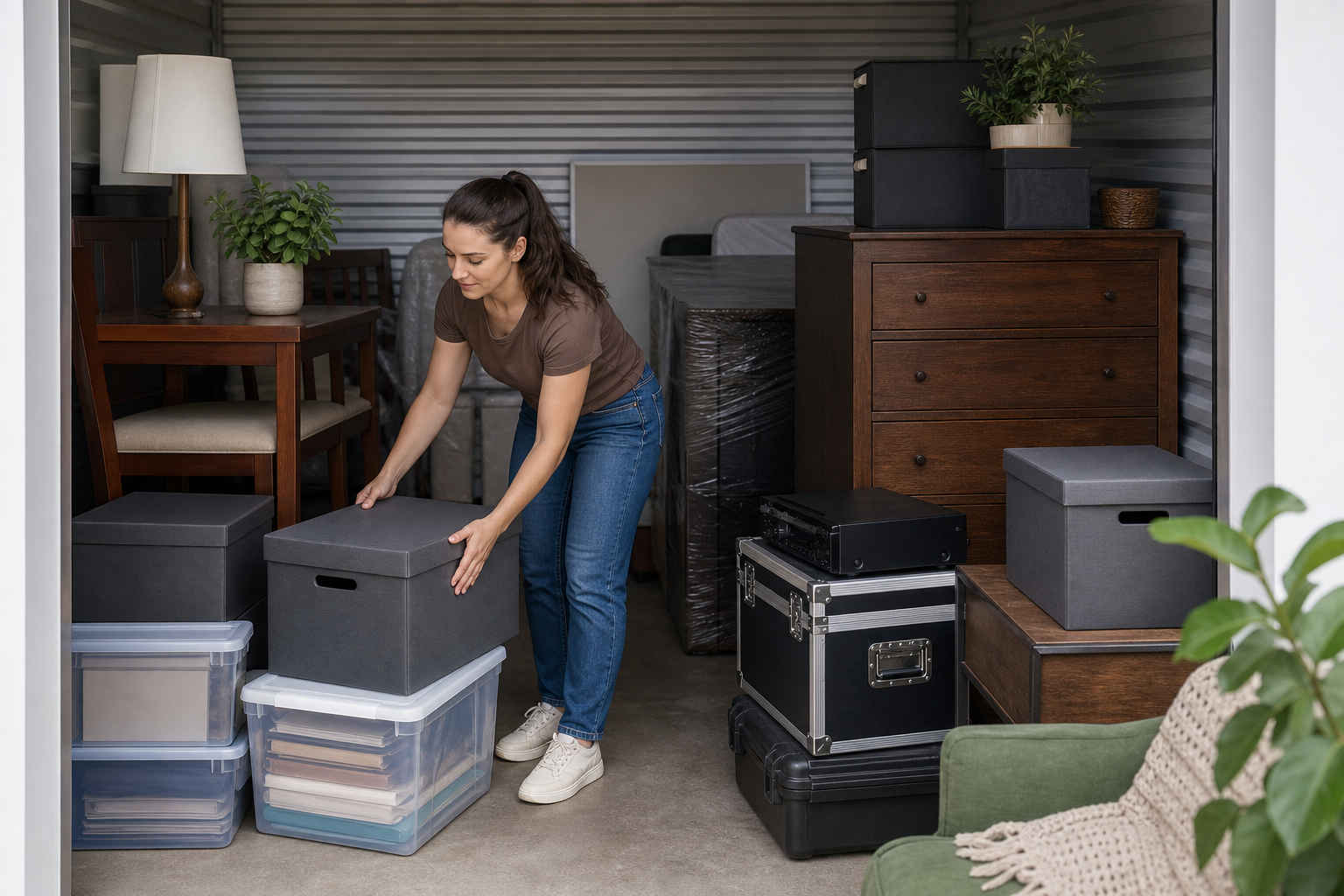
Wood expands, contracts, and cracks when temperatures swing, and glued joints loosen in persistent damp — which is why solid-wood and veneer pieces are among the strongest reasons to choose a controlled unit. But the unit alone isn't enough. Clean and wipe pieces dry before storing, and cover them with breathable furniture covers or moving blankets rather than plastic sheeting, which traps condensation against the finish.
- Clean and fully dry wood before it goes into storage
- Use breathable covers or blankets, not sealed plastic
- Disassemble legs and hardware to reduce stress on joints
Skip the plastic wrap on wood. If you must use it during transport, remove it once the piece is in the unit so trapped moisture can escape — breathable covers are what should stay on for the length of the stay.
#5Keep electronics away from heat spikes and moisture
Electronics are hit twice: heat stresses batteries and internal components, while moisture and condensation corrode contacts and boards. TVs, computers, audio gear, and gaming consoles hold up far better in a stable 55–80°F environment than in a metal unit that bakes on an Arkansas afternoon. If these are in your load, they're a clear vote for climate control.
- Remove batteries where possible to avoid leaks and corrosion
- Pad and box screens upright to prevent pressure cracks
- Acclimate to room temperature before turning devices back on
Let devices reach room temperature before powering them on after storage, and store them upright in original boxes or padded bins — a cold-to-warm swing can cause condensation inside a unit, so give electronics a day to acclimate before you plug anything in.
Quick summary
| Decision | What to check | Why it matters |
|---|---|---|
| What's going in | Whether wood, electronics, paper, photos, or fabric are in the load | One sensitive category can justify climate control for the whole unit |
| How long | Total rental length and whether it overlaps summer | Longer, hotter stays raise the odds of warping, corrosion, and mildew |
| Unit size | Smallest unit your load fits without cramming | Right-sizing controls cost and keeps airflow around items |
| Access type | Indoor vs. drive-up and the access hours | Controlled units are usually indoor; plan for a cart and check the hours |
| Price & fees | Monthly rate plus any recurring or admin fees | The cheapest promotion may not be the cheapest full rental |

Storage numbers worth checking
Use these numbers as decision anchors before comparing facilities. The goal is not to guess a perfect unit — it is to compare the same details across options.
List largest items, box count, and aisle needs.
Use these as comparison anchors.
Monthly rate, promo length, required fees.
Drive-up convenience vs. indoor protection.
| Check | What to compare | Why it matters |
|---|---|---|
| 5×10 | Boxes, small bedroom, seasonal items | A small unit can save money if it truly fits |
| 10×10 | Apartment contents or household overflow | Often a safer middle option for mixed items |
| 10×20 | Multi-room moves or large equipment | More room can reduce loading frustration |
| Climate control | Sensitive vs. durable belongings | Arkansas heat and humidity change the risk |
StorageGuide verdict
Use the article as a decision filter: choose the smallest unit that comfortably fits your load, use climate control for wood, electronics, documents, photos, and fabrics, prioritize access that matches your real schedule, and compare regular rates and fees before trusting the cheapest promotion.
Storage FAQs
Is climate-controlled storage really necessary in Arkansas?
It depends on what you're storing and for how long. For wood furniture, electronics, documents, photos, or fabric sitting through a hot, humid summer, it's worth it. For sturdy items in a short move, a standard unit is usually fine.
What temperature and humidity do these units maintain?
Climate-controlled units typically hold temperatures around 55–80°F and humidity roughly between 30–50% year-round, using HVAC and dehumidification to stay in that range regardless of outdoor weather.
Can I still use sealed bins and covers, or does the unit do everything?
You should still pack well. Use airtight plastic bins for paper, photos, and fabric, and breathable covers for wood furniture. Climate control manages the room; packing protects each item.
Is climate control worth the extra cost for a short-term move?
Usually not, if you're storing durable items for only a few weeks. The premium makes the most sense for stays of about three months or more, especially when they overlap the warm season.
Are climate-controlled units drive-up accessible?
Most are indoor to keep the environment stable, so you typically won't drive right up to the door. Plan to use a cart, and check the facility's access hours before you rent.
Find the right unit for what you're storing
Compare unit sizes and climate-controlled options, then match them to your items, your timeline, and the access hours that fit your schedule.